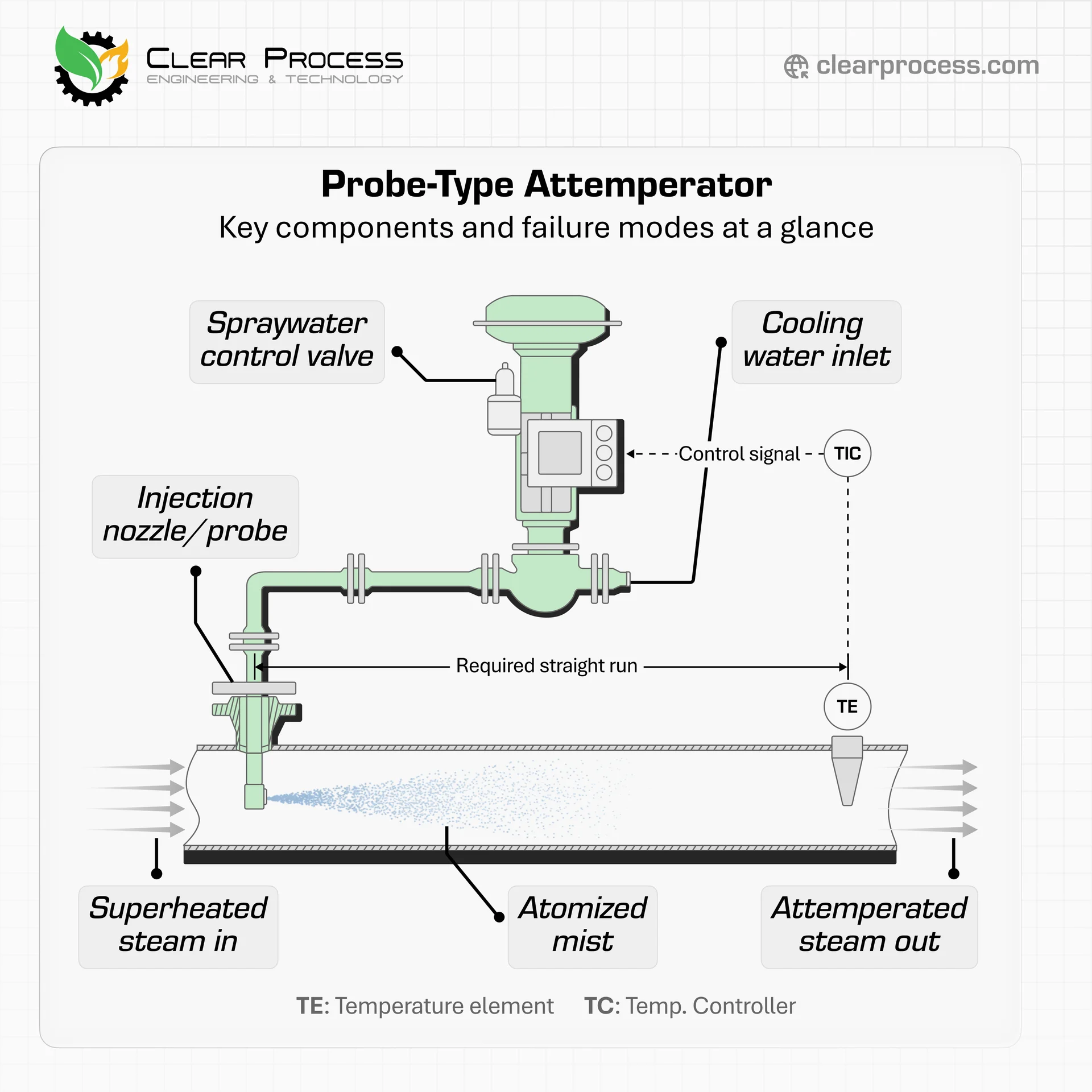
Superheat is essential for power generation turbine efficiency - but too much superheat (temperature) destroys downstream equipment. This makes the attemperator a critical control element for protecting assets.
A steam attemperator (also called a desuperheater in applications where superheated steam temperature is reduced to, or close to, saturation temperature) reduces superheated steam temperature by injecting finely atomized water directly into the steam flow. When applied correctly, the water evaporates nearly instantaneously, lowering steam temperature to the desired operator setpoint.
How a probe-type (nozzle) attemperator works
- Probe insertion: A nozzle assembly extends into the center of the main steam line, spraying water axially (parallel to steam flow).
- Water injection: Desuperheating water is injected and atomized through the nozzle tip, creating a cone of fine droplets.
- Evaporation: The high-velocity steam carries the droplets, which evaporate and absorb heat from the surrounding steam, thus reducing steam temperature.
- Control: A downstream temperature element provides feedback to the spray water control valve, modulating water flow to maintain the precise setpoint.
Common failure modes
Thermal fatigue cracking - Temperature differentials between steam and spray water can exceed 700 degrees F, causing severe thermal quenching of the probe assembly during cycling operations.
Water impingement - Poor atomization or oversized spray droplets strike pipe walls before evaporating, causing thermal shock and erosion.
Nozzle plugging - Feedwater contaminants or deposits restrict spray patterns, leading to temperature excursions.
Insufficient straight run - Inadequate downstream piping length prevents complete evaporation, sending water slugs into turbines or other equipment.
Boiler water chemicals - Certain boiler water treatment chemicals, when injected in the low pressure sections of the deaerator and boiler feedwater suction piping, precipitate out inside the superheater and cause fouling and eventually superheater failures.
Probe vs. ring-style designs
Probe-type designs remain common in stable-load industrial applications, while ring-style (circumferential) attemperators - which spray perpendicular to flow and keep control valves outside the hot steam environment - have become standard in cycling combined cycle plants due to better thermal fatigue resistance.
Inspection recommendations
Regular inspection of spray nozzles, diffuser internals, and downstream piping should be part of every steam system maintenance program. In addition, borescope inspections of the superheater tubes should include evaluation of scaling inside the tubes and evidence of localized overheating from said fouling.